

How To Clean Prickly Pear Cactus Stain Counyer
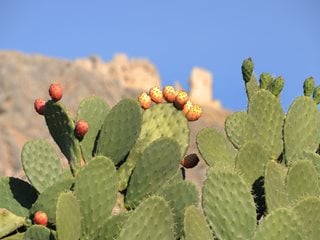
Photograph by: Halitomer / Shutterstock.
Prickly pears are a subgroup of Opuntia, identified by their wide, flat, branching pads, and are ofttimes chosen nopal cactus or paddle cactus. Most varieties take a combination of detachable spines and tufts of barbed bristles (glochids) that can cause significant allergic skin reactions. There are besides spineless varieties similar O. ellisiana and others.
The pads, flowers and fruit of almost varieties are edible after careful cleaning. Well-nigh prickly pear plants are establish in warm, dry climates similar the Southwest, although at that place are some common cold-hardy varieties such as the Eastern prickly pear (O. humifusa). As the plants prepare for winter, pads may brainstorm to await shriveled and wilted, but they volition green up apace in spring.
On this page: The Nuts | How To Plant | Care | Edible Prickly Pear | Pictures | Design Tips
- THE Basics
- HOW TO PLANT
- CARE
- EDIBLE PRICKLY PEARS
- PICTURES
- DESIGN TIPS
THE BASICS
Zones:
Generally zones nine-eleven; some varieties, such equally O. humifusa, are cold hardy to zone four.
Top/Spread:
Varieties range from 6- to 12-inch tall, 18-inch wide low-growing cactus to x- to 15-foot tall trees.
Exposure:
Full sunday
Bloom Fourth dimension:
June to July
Color:
Prickly pear flower colour varies by type, unremarkably yellowish, red or purple. Fruit colors can also vary in shades of cherry, green and yellow-orangish.
Other:
Because of their spiny nature, prickly pear cactus are deer resistant.
HOW TO PLANT
When to institute:
Cuttings tin can exist started at whatever time, but you may have better results if planted in spring or summer. Seeds should be started in late spring.
Where to found:
Prickly pears need a location that receives full lord's day with well-draining soil.
How to plant:
Transplant at the same level as they are currently growing; deeper planting may cause them to rot. Handle advisedly, not just for your ain safe, but the pads tin get superlative-heavy and suspension off. An actress pair of hands tin be valuable because prickly pears can be heavy and bad-mannered to elevator and place in the hole.
Other:
Wear thick gloves and heavy long sleeves to guard confronting being poked past a spine or touching the skin-irritating glochids.
Encounter more than on starting from seed or pad cuttings under Propagation.
CARE
Pruning:
Information technology's not necessary to prune prickly pears, but they tin be cut dorsum. Remove individual pads as needed to maintain shape and size. Use tongs to hold the pad and a sharp pocketknife to cut it off at the joint, or line where it connects to the next pad. Pads can exist calloused off to be planted elsewhere or shared with friends. Encounter more on propagating below.
Soil:
Prickly pears prefer alkaline to neutral soil. More chiefly, even so, the soil needs to bleed well, as rest wet or puddling can crusade the institute to rot.
Amendments & Fertilizer:
Fertilize young plants with a balanced 10-ten-10 fertilizer. For established plants, a 5-10-10 or even 0-10-x water-soluble fertilizer will promote more flowers and fruit. If you are growing for the pads, use a fertilizer that is high in nitrogen.
Watering:
Prickly pears are extremely drought tolerant. Don't water newly propagated pads for the offset month. After that, water every two to four weeks for the first yr — twice a month in summertime and once a month other times of the year. In most areas, rainfall volition be enough to sustain established plants. Supplement in times of drought with the twice-a-month/once-a-month seasonal schedule.

A new prickly pear growing from a pad cutting. Photo by: Selma Jacquet / Alamy Stock Photo.
Propagation:
Initial growth from seed is slow and it may take iii to 4 years before your plant produces flowers and fruit. The seeds need shade to germinate and should be kept moist until that fourth dimension.
Propagation from pads is much simpler and yields faster results. Here's how:
- Pads that are at least 6 months old tin can exist cutting off past following the pruning instructions above.
- Fix the pads out in a dry area with light shade and allow the cutting stop to class a callus. This prevents the new plant from rotting at the base and can accept 2 to iv weeks in warm, dry weather, longer if it is cool or boiling.
- In one case fully calloused over, plant pads in a mixture of half soil and one-half sand at a depth of ane inch. If planted any deeper, your plant can rot.
- Don't water information technology for the first calendar month, as there is plenty moisture within the pad to sustain itself.
- Prop it up with rocks or other means of support until roots grow over the next calendar month or so. After a month, there should be enough roots that your plant tin can stand on its own, just continue the support if it'south still a piddling wobbly.
- You tin water it at this time as well and follow the watering guidelines above, making sure to let it dry out completely in between.
On new plants, flowers and fruit will usually appear past the 2d or third pad that grows.
Diseases and Pests:
Prickly pears don't normally suffer from any serious disease or insect issues, although they can be affected by rot if grown with poor drainage.
EDIBLE PRICKLY PEARS

Photo by: Marco Mayer / Shutterstock.
Several types of prickly pears produce pads and fruit that are edible. The edible pads are often referred to as nopales and the fruit is commonly called tuna fruit.
Pads can be harvested whatsoever time of year, and up to 6 times per year on fast-growing plants, by post-obit the same instructions for pruning above.
When harvesting pads:
- Don't remove any more than than one-third of the full number of pads to keep your plant healthy and producing more pads.
- For the best season, remove them from the institute mid-morning when the acid content within them is at its lowest.
- Use tongs to hold them while cleaning and carefully scrape the pads and skin the fruit to remove all traces of spines and glochids; they can also exist roasted to burn them off.
Pads can be eaten raw or cooked. They take a lemony flavor and have a somewhat slimy texture like to okra when cooked.
The juicy red fruits are ripe when the glochids autumn off (usually around September) and should be twisted from the pad to remove, not pulled. The fruits tin be eaten raw or cooked and used for jams and jellies.
PICTURES
Swipe to view slides
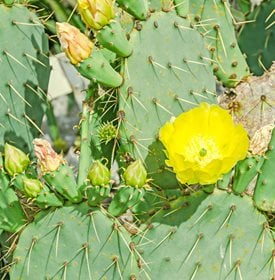
Photo by: Ncristian / Shutterstock.
Opuntia humifusa (syn. compressa)
Eastern prickly pear, devil's tongue
Zones: 4-9
Height/Spread: six to 12 inches alpine and 1 to two anxiety wide
Exposure: Full dominicus
Bloom time: June-July
Color: Bright greenish pads, yellowish flowers followed by cherry-red fruit
The only cactus widely found in eastern U.S., this cold-hardy variety handles snow and ice well.
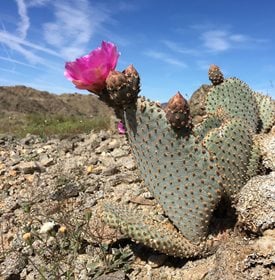
Photo by: Amberdiehl / Pixabay.com.
Opuntia basilaris
Beavertail cactus
Zones: 8-10
Summit/Spread: 6 to 12 inches alpine and upwardly to 4 feet wide
Exposure: Total lord's day
Bloom time: June-July
Color: Gray-bluish pads with imperial tint, bright pinkish-purple flowers followed past brownish-gray fruit
This southwest native lacks the large spines of other prickly pears. Birds are attracted to its fruits.
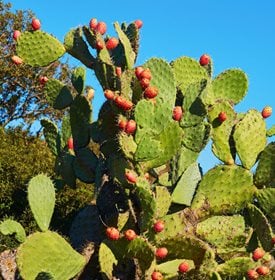
Photograph by: Ekaterina Pokrovsky / Shutterstock.
Opuntia ficus-indica
Indian fig, barbary fig
Zones: eight-11
Acme/Spread: 10 to xv feet tall and five to 10 feet wide
Exposure: Total sunday
Bloom fourth dimension: June-July
Color: Blueish-green pads; yellow, orange or red flowers followed by fruit that changes from yellow to cherry-red.
Many are spineless and besides lack glochids. This Opuntia starts out as a delicious shrub and somewhen matures with a woody body and becomes tree-like.
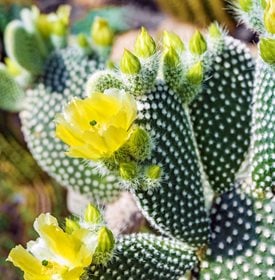
Photo by: Elgub / Shutterstock.
Opuntia microdasys
Bunny ears
Zones: viii-11
Height/Spread: iii to 4 anxiety wide, four to five anxiety alpine
Exposure: Full dominicus
Bloom fourth dimension: June-July
Color: New pads mature from red to dark green, yellow flowers followed by majestic or cherry-red fruit.
New pads appear in pairs, giving ascension to its nickname, bunny ears. Although spineless, this diverseness still packs a dial with numerous clusters of glochids that can cause pregnant pare irritation with the slightest touch.
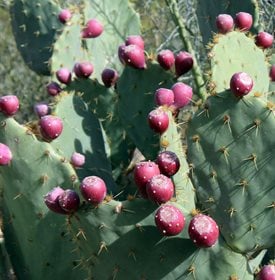
Photo past: Tracy Immodino / Shutterstock.
Opuntia engelmannii
Engelmann prickly pear, cow'due south tongue
Zones: 8-10
Top/Spread: three to 6 anxiety tall and wide
Exposure: Full sun
Bloom time: June-July
Color: Low-cal green to blue-green pads, yellow-orange flowers followed past majestic-red fruit
The spines on this multifariousness are relatively brusque, commonly about 1 inch.
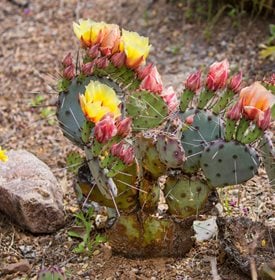
Photograph by: Blickwinkel / Alamy Stock Photo.
Opuntia macrocentra
Black-spine prickly pear, Texas Santa Rita
Zones: half dozen-xi
Height/Spread: 2 to 3 feet tall, 3 to 6 anxiety broad
Exposure: Full lord's day
Bloom time: June-July
Color: Bluish-dark-green pads turn purple in cold weather or drought, bright yellow flowers with red centre followed by royal-cherry fruit.
Some other variety that handles colder climates, with long nighttime spines that accent the blue-green or purple pads.
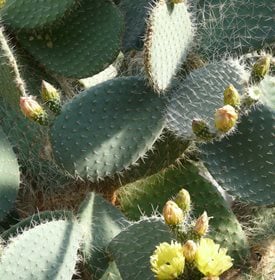
Photo by: Hans Braxmeier / Pixabay.com.
Opuntia robusta
Dinner plate nopal
Zones: ix-ten
Height/Spread: iii to 15 anxiety tall and wide
Exposure: Full sun
Bloom time: Bound
Color: Argent-blue pads, large brilliant yellow flowers followed by cherry-red fruit.
This big-growing variety tin with or without spines, and its fruit is better left for the birds.

Photo by: Riet Bloemen / Shutterstock.
Opuntia santa-rita
Santa Rita prickly pear, regal prickly pear
Zones: vii-11
Height/Spread: 6 to 8 anxiety tall, 8 to 10 feet wide
Exposure: Total sun
Bloom fourth dimension: June-July
Color: Bluish-gray pads turn purple in winter, xanthous flowers followed past purple fruit.
Birds are attracted to the small royal fruit of this colorful Opuntia.
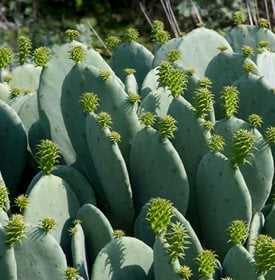
Photo by: Garden Globe Images, Ltd / Alamy Stock Photo.
Opuntia cacanapa 'Ellisiana'
Spineless prickly pear
Zones: half-dozen-x
Acme/Spread: 3 feet tall, 4 to 6 feet broad
Exposure: Full dominicus
Bloom fourth dimension: Mid-summertime
Color: Green pads, bright yellowish flowers followed by red fruit
This cold hardy variety is completely spineless and lacks glochids.
DESIGN TIPS
- Perfect choice for low-h2o, cactus, rock or rustic-style gardens.
- Suitable for containers, but they tin be quite elevation-heavy, so cull a sturdy container that won't tip over.
- In colder climates, plant non-hardy types in containers so they can be moved indoors.
- Consider the mature size of your Opuntia cactus and establish where information technology won't abound to interfere with pathways and unsuspecting passersby.
- Apply spineless varieties where people or animals might come up in contact with them, or simply to get the look and not the poke!
- Establish on sandy slopes or dry prairie areas.
Related: Agave Plants
Water-Wise Desert Plants
Types of Succulents

Source: https://www.gardendesign.com/succulents/prickly-pear.html
Posted by: shermandammand.blogspot.com
0 Response to "How To Clean Prickly Pear Cactus Stain Counyer"
Post a Comment